
Position Selection and Rotation in Youth Recreational Soccer
Position selection and rotation is one of the most debated topics in youth recreational soccer. Many organizations encourage players to experience all positions, avoid early specialization, and rotate roles over time.
For the recreational coach, the challenge is practical: what does rotation actually look like on a real team with limited practice time, wide differences in ability, and the pressures of game day? This article focuses on making thoughtful, realistic decisions that protect confidence, support development, and keep the team functioning as a whole.
A separate article discusses Setting the Game-Day Line-up
Key Principles
- Players should be given opportunities to try every position—but when and where that happens can vary.
- Trying a position does not automatically mean playing that position in a game.
- Rotation over time does not require forcing players to move on a fixed schedule.
- Constant in-game rotation throughout the entire season can sacrifice deeper learning that comes from spending meaningful time in one role. Balance matters.
- Kids generally have more fun and gain confidence when placed in positions where they can succeed.
- Equal playing time does not mean equal time at every position.
- Soccer is a team sport; team needs must play a role in position selection—though they should never be the only factor.
- Coaches are responsible for creating opportunities for players to discover hidden positional strengths, not for mechanically rotating players during games just to “check a box.”
- Protecting a child’s confidence and enjoyment is as important as skill development, especially in high-pressure positions.
- Positions are not permanent labels; they can change as players grow, mature, and gain confidence.
This approach protects confidence while still giving players meaningful chances to grow—within the real constraints of recreational soccer.
How Players Experience Different Positions
Players should experience different roles primarily through:
- Practice activities
- Early-season scrimmages
- Games
All settings are valid.
This framework also helps coaches build a functional team—offense, midfield, defense, and goalkeeper—that can handle the practical realities of game day and substitutions.
How to Learn Where Players Fit
At the first practice, ask each player a few simple questions:
- How many years have you played?
- What positions are you interested in or comfortable playing?
- Are there any positions you do not want to play?
- Are you interested in goalkeeper?

Then build the first few practices around small-sided games and larger-sided scrimmages. During free play, observe:
- Who naturally stays back and defends?
- Who drifts into the middle of the field?
- Who looks to get open up top and score?
- Who hangs back on the edges, unsure of where to go?
You can learn a great deal simply by watching how kids move.
Compare what players say they want to play with what you observe. Many kids say they want to be “striker,” but some of those same players instinctively drop back and protect the goal. That is a player worth trying in defense during a structured scrimmage or game.
Identifying Goalkeepers
For players interested in goalkeeper, dedicate practice time to evaluating them in a low-pressure setting. Take easy shots, have teammates shoot, and observe:
- Movement in goal
- Hand–eye coordination
- Comfort going to the ground (on a knee, on their side, etc.)
From there, develop a short list of potential goalkeepers to work with. This list may change over the season. However, goalkeeping has specific rules and responsibilities that must be taught, and it is not realistic to teach the entire team those rules in the detail needed with the limited practice time you have. You must be intentional about who you teach in depth.
If you have an assistant coach, they can be an excellent resource for goalkeeper breakout sessions.
Creating a Positional Framework
After the first few practices, create a working list of players who can play:
- Goalkeeper
- Defense
- Midfield
- Offense
Most players fall into one to three of these categories. This framework is extremely helpful for building lineups and planning substitutions.
For example:
- A player who says they want to play offense but consistently drifts into defensive positions—and shows interest in goalkeeper—may be tried in offense, rotated into defense, and included in goalkeeper evaluation.
- A player who clearly wants to play defense, naturally plays there during free play, and has no interest in goalkeeper does not need to be forcibly rotated through every position.
This list can change over time, will be what you use to generate your Game Day Line-up each week.
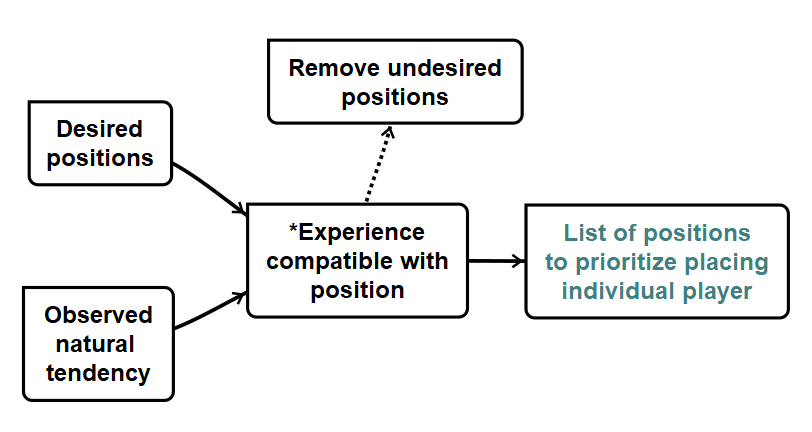
Rotation Is Not About Checking Boxes
You do not need to rotate every child into every possible position. For example, if a player has played left midfield, they do not automatically need to play right midfield.
Aiming for experience across offense, midfield, and defense is generally reasonable.
Your responsibility is to create opportunities—especially in practice—that reveal strengths in offense, midfield, defense, or goalkeeper. From there, you balance:
- Player interest
- Observed ability
- Confidence
- Team needs
A child placed in a position where they can succeed and contribute meaningfully is far more likely to gain confidence and enjoy the sport than a child forced into constant rotation simply to satisfy a rule.
Practice structure should allow players to try every position. Free play and scrimmages naturally support exploration. Playing a child in a particular position during a game, however, is not always the right decision.
Your goal is to stretch each player from where they are, not to rotate them mechanically.
For newer or more overwhelmed players, a new position every week can prevent them from ever finding their footing. One week midfield, the next defense, then offense, then goalkeeper—that approach often leads to confusion and frustration, not growth.
A better approach is to allow newer players to gain comfort and confidence in one role. When you begin to see them stretching within that role, move them to a related position—for example, an outside midfielder trying a wing position. Rotation is player-specific, and it will look different for each child.
When a Player Wants a Position They’re Not Ready For
If a player wants to try a new position, you should accommodate that within reason. You are not obligated to do so at the expense of the team or the player.
Recreational soccer has limited practice time. Placing a child into a critical position—such as goalkeeper or last-line defender—during a game when they are significantly behind others in readiness can set them up for failure. A player may eventually be well-suited for goalkeeper. But if they are placed there too early and experience repeated failure, the emotional impact can be lasting. Instead of building confidence, they may walk away believing they were the reason their team lost.
Protecting confidence matters.
Try new positions in practice. Reassess over time—especially if the player is putting in effort outside of practice to improve. But trying a position does not automatically mean playing it in a game. Give players specific guidance on how to prepare for the role they want.
A Note About Goalkeepers
If a player is a strong goalkeeper but also enjoys playing on the field, ensure they still receive meaningful field time. Exclusive goalkeeper play can limit development and enjoyment, especially at younger ages.
Age-Related Guidelines
- U6–U8: Maximum rotation, minimal specialization, focus on sampling all roles
- U10–U12: Gradual identification of preferences, still significant rotation
- U12+: More settled positions, with continued opportunities to try new roles
Balancing Exposure With Growth
Players should have opportunities to try different positions, particularly in practice and early in the season.
However, you cannot build a cohesive team if positions are constantly rotated throughout the entire season. Deeper positional learning requires repetition, and many players do not enjoy forced rotation. Depending on age, constant changes can overwhelm players and reduce confidence.
Forced rotation often sacrifices both development and enjoyment.
In summary: Provide every player opportunities to try every position, while gradually allowing them to settle into roles that feel like theirs and support deeper learning as the season progresses.